
TL;DR:
- South African landlord protections favor tenants, making eviction and default procedures lengthy and complex.
- Proper vetting, clear lease agreements, and legal action are essential for effective rent default management.
- Tenant default insurance provides financial security during legal processes, preventing cash flow crises.
A single missed rent payment can feel manageable. Two missed payments start to sting. By the third, you’re staring down legal fees, court dates, and months of carrying a property that generates nothing but costs. South African landlords face a particularly complex landscape because the law leans heavily towards tenant protections, especially in the residential sector, and even a watertight lease agreement cannot fully insulate you from the delays and losses that come with tenant default. The good news is that there are structured, proven steps you can take to reduce your exposure significantly before and after a default occurs.
Table of Contents
- Understanding why rent default happens
- Preparation: Prerequisites for reducing rent default risk
- Step-by-step guide for mitigation when tenants default
- Troubleshooting: Common mistakes and how to avoid them
- Verifying mitigation: What success looks like and next steps
- What most guides miss about rent default mitigation
- Protect your income with specialist insurance solutions
- Frequently asked questions
Key Takeaways
| Point | Details |
|---|---|
| Preparation is vital | Robust screening, strong leases, and clear communication reduce the odds and impact of rent default. |
| Legal steps are mandatory | Follow proper breach notices and court procedures to avoid costly mistakes or delays. |
| Avoid illegal shortcuts | Never lock out tenants or cut utilities as these actions are strictly prohibited and will backfire legally. |
| Mitigation is ongoing | Continually assess your processes, keep thorough records, and consider insurance for complete financial protection. |
Understanding why rent default happens
Before you can reduce your exposure, you need to know why defaults occur. Most landlords assume default is purely about a tenant’s dishonesty, but the reality is far more layered. Economic shocks, unexpected job losses, business failures, and even poor communication between landlord and tenant can all trigger non-payment. Understanding the root cause shapes how you respond.
The divide between residential and commercial risk is significant. Residential processes emphasise tenant protections under legislation such as the Prevention of Illegal Eviction Act (PIE) and the Rental Housing Act (RHA), which favour mediation and Tribunal processes first. Commercial leases, by contrast, are more contract-driven and allow for quicker resolution if the lease contains strong default and cancellation clauses.
Common reasons tenants default include:
- Sudden job loss or reduced household income
- Business cash flow problems (particularly for commercial tenants)
- Over-commitment to multiple financial obligations
- Poor vetting during the application stage, where affordability was not properly assessed
- Deliberate exploitation of slow legal timelines
- Domestic or personal crises that disrupt payment behaviour
Certain tenant default scenarios are especially tricky, such as tenants who partially pay, creating ambiguity about breach, or tenants who vacate without notice and leave arrears behind. Recognising these patterns early is the first layer of protection.
Preparation: Prerequisites for reducing rent default risk
Once you understand the risks, here’s what you can do upfront to reduce them. Prevention is always cheaper than cure, and the preparation phase is where landlords can do the most meaningful work.
Thorough tenant vetting is the foundation. Do not skip credit checks, employment verification, or previous landlord references. A single bad placement costs far more in legal fees and lost rent than any upfront screening effort.
Use the tenant screening guide to build a robust process that includes affordability ratios. A widely used benchmark is that a tenant’s gross monthly income should be at least three times the monthly rent. For commercial tenants, request audited financials or at least three months of bank statements.
Lease agreements must be precise and enforceable. Vague default clauses create room for dispute. Review your lease agreement essentials to confirm your document includes:
- Clear payment due dates and grace periods
- A defined breach notice period (typically 20 business days for residential)
- Explicit cancellation provisions in the event the breach is not remedied
- Deposit terms, interest on arrears, and legal cost recovery clauses
| Preparation step | Residential focus | Commercial focus |
|---|---|---|
| Credit and background check | Essential; use a registered bureau | Essential; include business credit check |
| Affordability assessment | 3x income rule | Request financial statements |
| Lease default clauses | Must comply with RHA | Can be more contract-driven |
| Deposit amount | Typically 1-2 months’ rent | Negotiable; often 2-3 months |
| Communication plan | Tribunal contact details included | Dispute resolution clause included |
Set up automated payment reminders via SMS or email a few days before rent is due. Many defaults begin as simple oversights, and a friendly reminder can prevent a minor cash flow hiccup from becoming a formal dispute.

Pro Tip: Keep an attorney or specialised rental legal service on retainer or at least on speed dial. The moment a tenant misses a payment, you want to move quickly, and knowing exactly who to call removes a critical delay.
Implementing strategies to prevent tenant default early, including site visits, periodic lease reviews, and proactive tenant communication, creates a landlord-tenant relationship built on accountability rather than assumption.
Step-by-step guide for mitigation when tenants default
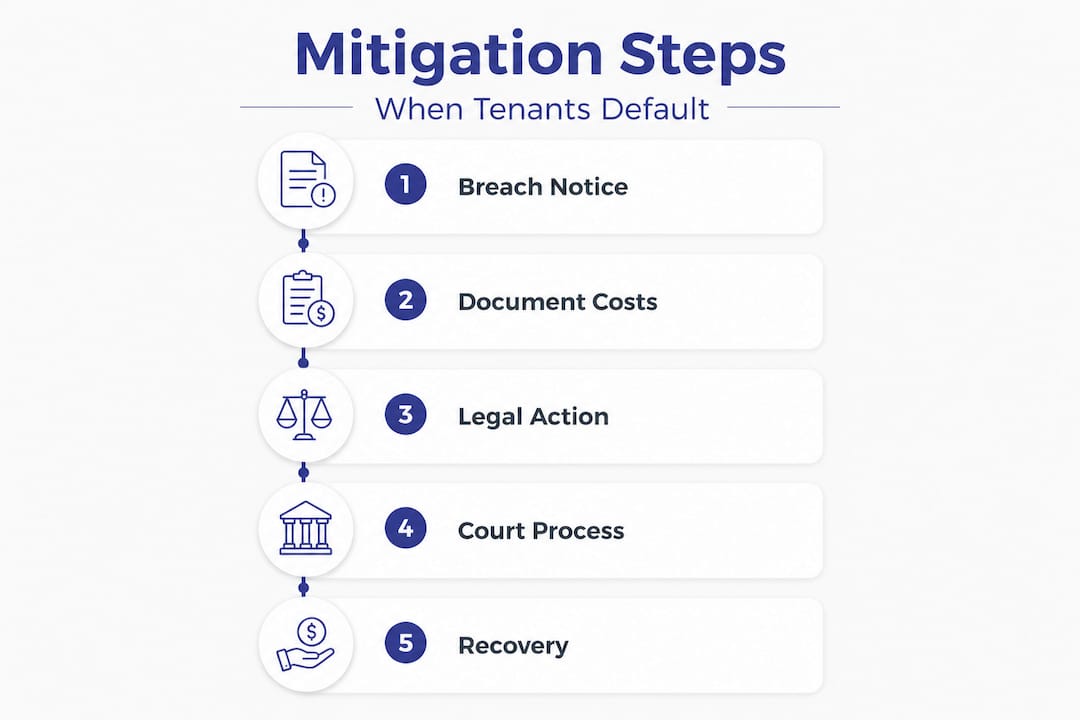
With strong preparation, you’re ready to act decisively if default occurs. The key is to follow the correct legal sequence without skipping steps, because shortcuts can invalidate your case entirely.
- Identify the default formally. As soon as rent is missed beyond the grace period, note the date and document the missed payment in writing.
- Issue a notice of breach. For residential tenants, this is typically a written notice giving 20 business days to remedy the breach. For commercial tenants, the timeframe depends on your lease terms but is usually shorter.
- Allow the remedy period to lapse. If the tenant pays within the period, the breach is cured. If not, you may proceed to cancel the lease.
- Cancel the lease formally. Send a written cancellation notice. Do not accept partial payments without a written reservation of rights, as acceptance could imply reinstatement of the lease.
- Apply to court for an eviction order. This is non-negotiable. You cannot remove a tenant without a court order. Both the Magistrates’ Court and the High Court have jurisdiction depending on the circumstances.
- Obtain the eviction order and instruct the sheriff. Only a sheriff of the court may lawfully execute an eviction. Any other action is illegal self-help.
The eviction process timeline varies considerably: unopposed residential evictions typically take 3 to 6 months, while contested residential cases can stretch to 12 to 18 months. Commercial evictions tend to resolve faster when the lease allows unilateral cancellation.
| Process stage | Residential timeline | Commercial timeline |
|---|---|---|
| Breach notice period | 20 business days | As per lease (often 7-14 days) |
| Lease cancellation notice | Separate written notice | Immediate if unpaid after notice |
| Court application to order | 6-12 weeks unopposed | Varies; often faster |
| Total (unopposed) | 3-6 months | Potentially 1-3 months |
| Total (contested) | 12-18 months | Depends on lease terms |
For commercial properties, the process follows the lease terms closely: a formal breach notice is issued, if not remedied the lease is cancelled, a court application is lodged, an eviction order is obtained, and the sheriff enforces it. The PIE Act applies less stringently to commercial tenants, giving landlords more leverage.
Pro Tip: Use the waiting period during legal proceedings to document all costs meticulously. Accumulated arrears, legal fees, and any property damage should all be recorded and supported by invoices or statements. These records strengthen your damages claim.
The rent default management guide and detailed notes on tenant default insurance can help you understand both the procedural and financial dimensions of this phase in detail.
Troubleshooting: Common mistakes and how to avoid them
Even well-intentioned landlords can make mistakes under pressure. The financial strain of unpaid rent creates a temptation to take shortcuts, but those shortcuts carry serious legal consequences.
“The moment a landlord changes a lock, cuts off water, or removes a tenant’s belongings without a court order, they have committed an illegal act, regardless of how much money the tenant owes.” This is not a grey area in South African law.
The most damaging mistakes landlords make during defaults include:
- Illegal self-help: Changing locks, cutting electricity or water, removing doors, or intimidating tenants into leaving. Self-help measures such as these are illegal and expose you to criminal charges and civil claims.
- Ignoring vulnerable tenant status: Under the PIE Act, tenants who are elderly, disabled, or living with young children have additional protections. Courts take these into account when granting eviction orders, and vulnerable tenants can delay evictions significantly.
- Accepting partial payments carelessly: If you accept even a partial payment without explicitly reserving your rights in writing, a court may interpret this as waiver of the breach, resetting the entire process.
- Delaying formal action: Many landlords wait three or four months before issuing a breach notice, hoping the situation resolves itself. Every month of delay is another month of income loss and a longer overall process.
- Failing to document communication: Verbal agreements, verbal warnings, and verbal promises mean nothing in court. Every interaction with a defaulting tenant must be in writing, whether by email, registered post, or WhatsApp with read receipts.
Understanding the role of insurance in tenant disputes becomes especially relevant here, because insurance can absorb the financial hit while you follow the correct legal process without being forced into reckless shortcuts by cash flow desperation.
Verifying mitigation: What success looks like and next steps
After addressing default, confirm your steps actually protect your income going forward. Too many landlords treat the end of a tenancy dispute as the finish line, when it is really the starting point for refining their approach.
A well-managed default resolution should show clear indicators:
- Rent arrears were formally claimed and at least partially recovered
- Legal steps were followed in sequence without procedural errors
- The property was returned in acceptable condition or damages were documented
- Total losses were contained within a measurable and insurable range
- A new tenant was placed using improved vetting criteria
| Success indicator | What to measure | Ideal outcome |
|---|---|---|
| Income recovery | Months of arrears collected | Full recovery or insured shortfall |
| Legal process integrity | Steps followed in correct order | No procedural errors |
| Time to resolution | Total months from default to re-let | Within expected timelines |
| Property condition | Documented inspection report | Damage claimed and remedied |
| Future risk reduction | Updated vetting and lease terms | Stronger prevention for next tenant |
Keep the following records permanently:
- All written correspondence with the defaulting tenant
- Signed lease agreement and any addenda
- Payment history including deposits, receipts, and arrears statements
- Court documents, legal fee invoices, and the eviction order itself
- Entry and exit inspection reports with photographs
When to update your processes: after every default, review what could have been caught earlier. If defaults are recurring across your portfolio, consider whether your vetting process needs strengthening, your lease terms need tightening, or your property mix requires a different risk strategy.
Reviewing rental insurance options available to South African landlords is a natural next step. Understanding the role of landlord insurance within your broader risk strategy can be the difference between a single bad tenant ruining your year and a managed, insured shortfall that barely disrupts your cash flow.
What most guides miss about rent default mitigation
Most guides walk you through the legal steps in a clear, reassuring sequence. What they underplay is the cumulative cost of managing defaults, not just in money, but in time, focus, and stress.
Here is what years of working with South African landlords has shown us: the legal process works, but it is slow, and slowness has a price. Even when you follow every step correctly, you may spend six months with a non-paying tenant in your property, paying rates, levies, mortgage instalments, and legal fees from your own pocket. The process protects your rights. It does not protect your cash flow.
Tenant screening is essential, but it is not a guarantee. South Africa’s economic instability means that a tenant who qualifies perfectly in January can be retrenched by March. No credit bureau report predicts an employer going into liquidation or a sectoral wage freeze. Mitigation strategies that rely purely on prevention are incomplete.
The landlords who weather defaults best are those who treat rent default mitigation as three parallel tracks running simultaneously: the legal track (correct process, proper notices, court steps), the people track (communication, de-escalation, negotiated exits where possible), and the financial track (insurance or reserves that cover the gap while the legal and people tracks play out).
Rental income protection is the financial track made practical. It removes the desperation that pushes landlords into illegal self-help and allows them to follow the correct process without being financially destroyed in the meantime. Most landlords underestimate how much clearer their thinking becomes when they know their income is covered for the months a dispute takes to resolve.
Protect your income with specialist insurance solutions
For landlords who want true financial security, insurance makes the difference between a stressful ordeal and a managed setback.

Legal steps protect your rights; insurance protects your income while those rights are being enforced. At Rental Income Insurance, we cover tenant non-payment, early lease termination, and absconding, giving you a financial buffer precisely when the legal process is at its slowest. Whether you own a single flat or a commercial portfolio, our solutions are designed for South African landlords who cannot afford to leave their income exposed. Start with our guide to tenant non-payment to understand what you’re protected against, explore the full rental income protection guide, and get a quote today to see how straightforward cover can be.
Frequently asked questions
What is the typical eviction timeline for defaulting tenants in South Africa?
Unopposed residential evictions typically take 3 to 6 months, while contested cases may extend to 12 to 18 months; commercial evictions are often resolved faster when the lease allows for unilateral cancellation.
What legal steps must landlords follow before evicting a tenant for non-payment?
Landlords must issue a formal breach notice, allow time for the tenant to remedy the default, formally cancel the lease if unpaid, and apply to court for an eviction order before a sheriff can enforce removal.
Are there special protections for vulnerable tenants?
Yes, the PIE Act provides additional protections for vulnerable tenants including children, the elderly, and disabled persons, and courts take these circumstances into account when deciding eviction applications.
Can a landlord cut off utilities or change locks if rent is unpaid?
No. Self-help measures such as these are illegal in South Africa regardless of how much rent is owed, and landlords who take such actions risk criminal charges and civil liability.
Recommended
- Rent default management guide for South African landlords 2026 – Rental Income Insurance
- Rent Default Explained: Safeguarding Landlord Income – Rental Income Insurance
- Why tenants default on rent in South Africa: protection – Rental Income Insurance
- How to Minimise Rental Risks for South African Landlords – Rental Income Insurance
- Essential landlord roles in leasing: A Singapore guide