
TL;DR:
- Insurers require strict compliance with South African law before paying rent protection claims.
- Proper documentation and adherence to procedures like the 20-day breach notice are essential.
- Most claim rejections result from procedural errors rather than tenant default severity.
Many South African landlords take out rent protection insurance expecting a simple process when things go wrong. The reality is quite different. Insurers require strict compliance with South African law before they will pay out a single rand, meaning that even the most clear-cut case of tenant non-payment can be rejected if you have not followed the correct legal steps. According to Property24, landlords must comply with processes such as the 20-day breach notice before cancellation or eviction to validate claims, as insurers require proof of adherence to the Rental Housing Act. This guide walks you through every stage clearly and practically.
Table of Contents
- What is rent protection and why does the claims process matter?
- Step-by-step claims process for South African landlords
- Common mistakes and how to avoid claim rejections
- What to expect after submitting your rent protection claim
- Why legal compliance is more important than ever in rent protection claims
- Protect your rental income: Next steps for SA landlords
- Frequently asked questions
Key Takeaways
| Point | Details |
|---|---|
| Legal compliance is vital | Insurers require strict proof that you have followed Rental Housing Act procedures during the claims process. |
| Thorough documentation pays | Keeping full records and written notices greatly improves claim approval chances. |
| Avoid common pitfalls | Missed deadlines and incomplete paperwork are the main reasons claims are rejected. |
| Step-by-step process helps | Following a clear sequence streamlines your rent protection claim for a faster payout. |
What is rent protection and why does the claims process matter?
Rent protection insurance is a specialist product designed to replace your rental income when a tenant fails to pay, absconds, or terminates their lease early. It can also cover costs related to property damage caused by tenants. For South African property owners, it serves as a financial safety net that bridges the gap between the moment income stops and the moment a problematic tenancy is legally resolved.
The cover typically includes:
- Tenant non-payment of rent for one or more months
- Early lease termination without proper notice
- Tenant absconding without settling outstanding rent
- Property damage beyond normal wear and tear
What many landlords overlook is that the cover does not activate automatically. You must follow a structured process, and any shortcut can invalidate your claim entirely. Understanding the claims process explained before you ever need to use it is one of the most valuable things you can do as a property investor.
Insurers do not simply take your word that a tenant has defaulted. They need documented proof that you have acted lawfully at every step. South African landlord-tenant law is governed primarily by the Rental Housing Act 50 of 1999, and it prescribes specific procedures that must be followed before a landlord can cancel a lease or pursue eviction. Critically, landlords must comply with the 20-day breach notice before cancellation or eviction, and insurers use this as a benchmark for whether your claim is valid.
“A claim is only as strong as the paper trail behind it. Insurers are not in the business of paying out on incomplete or non-compliant submissions.”
This means the claims process matters far more than most landlords realise. Getting it right the first time saves you weeks of back-and-forth with your insurer, protects your cash flow, and ensures the insurance you are paying for actually does its job when you need it most.

Step-by-step claims process for South African landlords
Now that you have seen the importance of compliance, here is exactly what you need to do from start to finish. Following these steps in the correct order gives you the strongest possible foundation for a successful claim.
-
Identify the breach and document it immediately. The moment your tenant misses a payment or breaches the lease in another way, note the date and amount. Keep your bank statements, your lease agreement, and any payment schedule readily accessible.
-
Issue a formal 20-day breach notice in writing. South African law requires you to give your tenant written notice of the breach and allow them 20 days to remedy it. This notice must be delivered correctly, either by hand with a signed acknowledgement, by registered post, or by another method specified in your lease. A verbal warning counts for nothing.
-
Wait out the 20-day period and record the outcome. If the tenant remedies the breach within the 20 days, document that too. If they do not, you have grounds to cancel the lease. Keep a copy of every message, email, and letter exchanged during this period.
-
Cancel the lease in writing and notify the tenant. If the breach remains unresolved, issue a formal written notice of lease cancellation. This letter becomes a critical piece of evidence for your insurer.
-
Gather all supporting documentation. This is where many claims stall. Compile your lease agreement, payment records showing arrears, the breach notice with proof of delivery, the cancellation notice, and a full log of all communication with the tenant.
-
Submit your claim to your insurer. Use your insurer’s official claim form and attach every document in your file. The more complete your submission, the faster the process. Refer to the detailed claim process step-by-step guide for specifics relevant to your policy.
Pro Tip: Create a dedicated folder for each tenancy, physical or digital, from the very first day. Include the signed lease, tenant ID copy, move-in inspection report, and every communication thread. This single habit makes the claims process significantly faster and less stressful.
Insurers require proof of adherence to the Rental Housing Act to validate claims, which means your paperwork is not just helpful, it is the entire basis of your payout. Use the insurance claim checklist to make sure nothing is missing before you submit.
| Step | Required evidence | Typical timeframe |
|---|---|---|
| Breach identified | Bank statements, lease agreement | Day 1 |
| 20-day breach notice issued | Written notice, proof of delivery | Day 1 to 3 |
| Breach period elapses | Communication log, written responses | 20 days |
| Lease cancellation notice | Written cancellation letter | Day 21 onwards |
| Claim submitted | Full documentation package | Within 30 days of cancellation |
| Insurer assessment | All of the above reviewed | 2 to 6 weeks |
Keeping this timeline in mind means you are never caught off guard by what comes next. Visit our rental insurance claims page for further guidance on timing your submission correctly.
Common mistakes and how to avoid claim rejections
Having seen the process, landlords should also be aware of the errors that most frequently stall or derail valid claims. The painful reality is that many rejected claims are not rejected because the landlord was wrong. They are rejected because the landlord did not follow the correct procedure, regardless of how legitimate the underlying complaint was.
The most common reasons for claim rejections include:
- Missing or incorrectly served breach notices. If you issued the 20-day notice verbally, by WhatsApp alone, or without proof of delivery, most insurers will not accept it.
- Incomplete paperwork at submission. Forgetting to include a signed lease, proof of arrears, or the cancellation notice is enough to trigger a query and delay your payout by weeks.
- Acting too quickly. Cancelling the lease before the 20-day period has elapsed, even by one day, can technically invalidate your claim.
- No record of ongoing communication. Insurers want to see that you engaged with the tenant throughout the process, not just at the start and end.
- Undocumented property damage claims. If you are claiming for damage, you need a pre-occupation inspection report signed by both parties, clear photographic evidence, and contractor quotes or invoices for repairs.
“Landlords who skip legal steps because a case feels obvious are the ones who end up out of pocket. Insurers follow the law, not instinct.”
Landlords must comply with the 20-day breach notice and eviction protocols as required by South African law before insurers will pay out. There is no grey area here. The requirement exists whether or not your tenant is clearly in the wrong.
Pro Tip: Never rely on a single channel of communication. If you send a notice by email, follow it up with a registered letter. If the tenant acknowledges receipt via WhatsApp, screenshot it and add it to the file. Redundancy in your records is never a waste of effort.
Understanding the most frequent insurance claim pitfalls helps you build better habits from the start of every tenancy. If you have already received a rejection or are concerned about a current submission, consult the claim rejections guide for practical remediation steps.
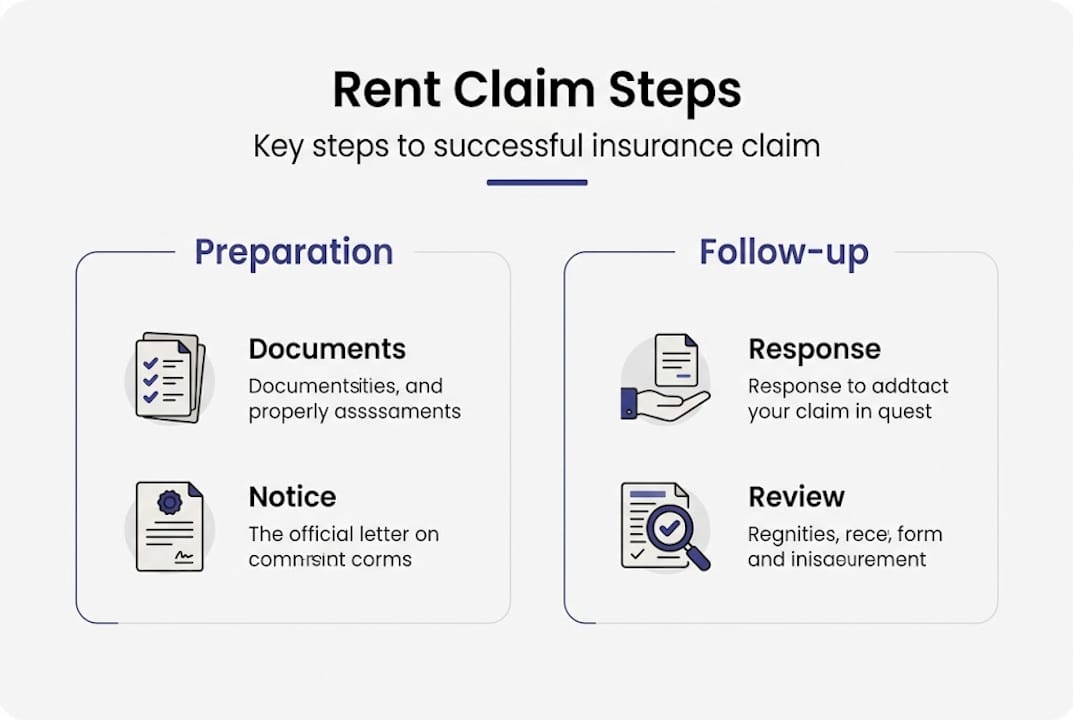
What to expect after submitting your rent protection claim
But what happens once you have submitted all the right papers and followed the claim process correctly? Understanding this phase is just as important as the submission itself, because it helps you stay composed and responsive during the review period.
Once your insurer receives your claim, they will assign it to an assessor who reviews every document against the policy terms and the applicable South African legal requirements. Proof of legal compliance, such as notices and full documentation, is assessed before insurers pay out. This is not a formality. The assessor checks dates, verifies notice delivery, and confirms that the sequence of events matches the law.
Here is what the post-submission phase typically looks like:
- Initial acknowledgement (1 to 3 business days): Your insurer confirms receipt of your claim and assigns a reference number.
- Documentation review (1 to 3 weeks): The assessor examines your file. If anything is missing or unclear, they will send a query requesting additional information.
- Query response period: If you receive a query, respond quickly and completely. Delays at this stage are your responsibility and extend your waiting time.
- Assessment decision: The insurer either approves, partially approves, or declines the claim, with reasons provided in writing.
- Payout processing: Approved claims are typically paid within a few business days of the decision.
| Scenario | Likely outcome | Typical timeline |
|---|---|---|
| Complete, compliant submission | Smooth approval | 2 to 4 weeks |
| Minor documentation gaps | Query issued, short delay | 4 to 6 weeks |
| Non-compliant notices | Possible rejection | 4 to 8 weeks |
| Missing lease or inspection report | Query or rejection | Varies |
The biggest thing you can do after submission is remain available and responsive. Check your email daily and be ready to provide additional documents at short notice. Insurers work to internal timelines, and a prompt response on your end keeps things moving.
The rental income protection guide offers further detail on policy-specific timeframes. It is also worth reviewing the step-by-step process to confirm your submission covered every required element before the assessor raises a query.
One often overlooked tip is to use each claim experience, successful or otherwise, as an opportunity to strengthen your documentation system for future tenancies. Update your inspection report template, refine your notice-serving procedure, and ensure every new lease is signed in full before keys are handed over.
Why legal compliance is more important than ever in rent protection claims
Here is something that rarely gets said plainly enough: most landlords who lose their claims do not lose them because of fraud or bad faith. They lose them because they underestimated how literally insurers interpret South African tenancy law.
We have seen it repeatedly. A landlord has an undeniably non-paying tenant, years of rental history as evidence, and a clear-cut case by any common-sense standard. Yet the claim fails because the breach notice was sent by email only with no delivery confirmation, or because the 20-day window was cut short by two days when the landlord panicked and cancelled the lease early.
Legal compliance in rent protection is not a box-ticking exercise. It is the substance of your claim. Insurers require proof of adherence to the Rental Housing Act, and they apply that standard regardless of how sympathetic your situation is. A missed deadline carries the same weight as a missing document. Both create grounds for rejection.
The landlords who consistently succeed with claims are not the ones with the worst tenants. They are the ones with the best records. Thorough documentation is not just your best defence, it is the only defence that actually works when it counts. Understanding the claim process realities gives you that edge from the very beginning.
Protect your rental income: Next steps for SA landlords
Knowing the process is powerful. Acting on that knowledge before a problem arises is even more so.

At Rental Income Insurance, we help South African landlords secure their rental income before tenant issues become financial crises. Whether you are a first-time landlord or managing a full portfolio, having the right cover in place means you are never starting from zero when things go wrong. Take a moment to learn about rental income insurance and understand exactly what your policy should cover. When you are ready to move forward, request a quote and find out how straightforward it can be to protect the income your investment depends on.
Frequently asked questions
What documents are needed for a rent protection claim in South Africa?
You need your lease agreement, proof of arrears, all breach and eviction notices, and a detailed record of communication with the tenant. Insurers require proof of adherence to the Rental Housing Act to validate claims, so every document must show legal compliance.
How long does it take to process a rent protection claim?
The review can take several weeks, depending on how complete and compliant your documentation is. Landlords must comply with processes such as the 20-day breach notice before the insurer will begin assessment, so delays often start before submission.
Why are rent protection claims in South Africa sometimes rejected?
Most claim rejections happen due to missed notice periods, incomplete paperwork, or non-compliance with the Rental Housing Act. SA legal compliance is assessed rigorously, and even minor procedural gaps can result in a full rejection.
Is rent protection insurance worth it for South African landlords?
Yes, it can prevent significant income loss from tenant non-payment or property damage when claims are properly submitted. Insurers validate claims based on legal compliance, so landlords who follow the correct process reliably benefit from the cover.
Recommended
- Essential Steps to Safeguard Rental Income Effectively – Rental Income Insurance
- Insurance claim checklist: secure your SA rental income – Rental Income Insurance
- How to Claim Rental Income Insurance: Step-by-Step Guide – Rental Income Insurance
- Claim Rental Insurance Process: Step-by-Step for Landlords