
TL;DR:
- Fair rental value must be justified by documented, objective market and property-specific data.
- Proper process, including written notices and current comparables, is essential to defend rent at tribunals.
- Relying on assumptions or outdated data risks costly disputes and financial losses.
Many South African landlords believe they can set rent increases at any percentage they choose, so long as it seems reasonable to them. This assumption is not only wrong but it can expose you to costly tribunal disputes, forced back-payments, and significant loss of rental income. South African law, as set out in the Rental Housing Act, requires that all rent-related determinations be fair and reasonable, with disputes settled by the Rental Housing Tribunal. This article breaks down exactly what fair rental value means, how it is determined, and what you need to do to protect your investment.
Table of Contents
- What does fair rental value really mean?
- How is fair rental value determined in South Africa?
- Common pitfalls and risks when setting rental value
- Fair rental value in action: Practical examples and tools
- What most landlords miss about fair rental value
- Protect your fair rental value (and your income)
- Frequently asked questions
Key Takeaways
| Point | Details |
|---|---|
| No fixed rent cap | Increases must be fair and justifiable, not simply a percentage limit. |
| Legal evidence matters | Keep documented comparables and clear records of rent changes to protect your position. |
| Market trends count | Regularly compare your property to similar rentals and adjust as needed. |
| Process beats gut feeling | Follow proper procedure, document every step, and communicate clearly with tenants. |
| Insurance reduces risk | Rental income insurance can safeguard your income even if rental disputes arise. |
What does fair rental value really mean?
Before you can protect your rental income, you need to understand the concept that underpins every legitimate rental agreement in South Africa. Fair rental value is not simply the amount you want to charge or the figure your neighbour mentions over the fence. It is a legally grounded concept that balances your right to a realistic return on your investment against a tenant’s right to pay a justifiable amount.
The Rental Housing Act is clear that rulings on rental payable must be “just and equitable to both tenant and landlord, taking due cognisance of prevailing supply/demand conditions and the need for a realistic return on investment.” This is not a vague aspiration. It is the standard against which the Rental Housing Tribunal will measure your rental amount if a dispute arises.
It is also important to distinguish between fair rental value and market rent. Market rent is what similar properties in your area are currently fetching. Fair rental value, however, goes a step further. It incorporates market rent as one of several inputs, but also weighs lease terms, the specific features of your property, and the documented supply and demand conditions in your area. A property with a private garden, secure parking, and fibre-ready infrastructure in a high-demand suburb will have a different fair rental value than an identical square footage flat without those features in a lower-demand area.
Key factors considered when determining fair rental value include:
- Property features: Size, number of bedrooms and bathrooms, security, parking, and amenities
- Location: Proximity to schools, public transport, commercial hubs, and safety ratings
- Market demand: Vacancy rates in the area and the ratio of available rentals to prospective tenants
- Lease terms: Length of the lease, included utilities, and any special provisions agreed upon
- Condition of the property: Recently renovated versus older, unmaintained units attract different valuations
Understanding fair rental value coverage is a crucial first step in building a defensible rental business. When your rental amount is grounded in documented, objective factors, you are far better placed to justify it at a tribunal, negotiate confidently with tenants, and ensure your income remains protected over the long term.
“A rental amount that cannot be explained with evidence is a rental amount that cannot be defended. Fair value is not a feeling—it is a documented position.”
How is fair rental value determined in South Africa?
Understanding what fair means leads naturally to the practical question of how landlords actually calculate it. The process is more structured than most landlords assume, and getting it right from the outset saves you enormous time, money, and stress later. Here is a clear, step-by-step approach to determining fair rental value in the South African context.
-
Gather comparable rentals. Start by researching what similar properties in the same suburb or neighbourhood are currently renting for. Use reputable property portals such as Property24 and Private Property, but also speak to local estate agents who have real-time insight. Look for properties that match yours in size, bedroom count, and general condition. Aim to collect at least three to five current comparables.
-
Adjust for specific features and location differences. No two properties are identical. If your property has a double garage and a comparable only has a single carport, adjust your benchmark upward accordingly. If your property is in a quieter street further from amenities, you may need to adjust downward. The goal is to arrive at an adjusted figure that fairly reflects what your specific property would attract on the open market today.
-
Review and factor in your lease terms. A long-term lease of two years offers the tenant security and you stability. This can justify a slightly different rental figure than a month-to-month arrangement. Similarly, if utilities such as water or electricity are included, this must be factored into the overall value equation.
-
Document everything in writing. This is where most landlords fall short. Every rental increase must be communicated in writing, with proper notice as stipulated in your lease agreement. Keep a file of your comparables, the date you gathered the data, and the adjustment calculations you used. The Rental Housing Act favours landlords who can produce documented comparables and proper written notice because this evidence directly supports the “just and equitable” standard required in tribunal rulings.
-
Update your data regularly. Market conditions in South Africa shift. Interest rates, loadshedding impacts on certain areas, and migration patterns all affect demand. Review your rental benchmark at least once a year, or before any proposed increase.
-
Incorporate risk assessment in rental insurance into your review process. Insurance providers assess your property and rental value as part of underwriting, which can give you a useful external perspective on whether your rental amount is realistic and defensible.
Pro Tip: Create a simple rental review folder for each property. Include printed or saved screenshots of comparables, dates, your calculation notes, and copies of all written notices to tenants. If you ever face a tribunal, this folder is your first line of defence.
Common pitfalls and risks when setting rental value
Now that you understand the legal process for setting and proving your rent is fair, it is vital to be aware of the mistakes that can expose you to costly disputes. Landlords across South Africa repeatedly make the same errors, and the consequences range from tribunal orders to significant financial loss.
Common pitfalls to avoid include:
-
Assuming there is a fixed percentage cap. Many landlords believe they are entitled to increase rent by a specific percentage each year, such as the consumer price index (CPI) figure. While CPI is a useful reference point, guidance sources note there is no fixed national limit on increases. All increases must still be fair and in line with market trends and your lease terms. Relying on a fixed number without market evidence can backfire.
-
Using outdated comparables. A rental survey you conducted two years ago is largely useless in a tribunal setting. The market evolves quickly, particularly in urban centres. Outdated data does not meet the standard of demonstrating current market conditions.
-
Not giving proper written notice. Verbal discussions about rent increases are not enforceable and will not protect you at a tribunal. Written notice, delivered within the period specified in your lease, is non-negotiable.
-
Failing to benchmark against genuinely similar properties. Comparing your modest two-bedroom flat in Bellville to a luxury apartment in Constantia is not a valid comparison. The Tribunal will see through poorly matched comparables immediately.
-
Ignoring the cumulative impact of poor documentation. Even if your rental amount is entirely reasonable, a lack of documentation makes it indefensible. Tribunals value evidence and process. Without them, even a fair landlord can lose.
The legal risks are real. A landlord who loses at the Rental Housing Tribunal can be ordered to reduce the rent, refund overpayments, or face additional penalties. Understanding rental insurance essentials and how rental property insurance can complement your risk management approach is increasingly important in this environment.
Pro Tip: Before issuing any rental increase, ask yourself: “Can I back this up with three current comparables and a written notice delivered on time?” If the answer is no, pause and gather your evidence first.
Fair rental value in action: Practical examples and tools
Awareness of risk is just the start. Here is how these rules play out on the ground, and how you can protect yourself and your income with practical tools and real-world frameworks.

Scenario one: Suburban two-bedroom flat vs inner-city studio. Consider a landlord managing a two-bedroom flat in a secure complex in Pretoria East, fully fitted kitchen, one bathroom, and covered parking. The monthly rental is R9,500. A comparable search reveals similar units in the same suburb ranging from R9,000 to R10,200 per month. The landlord’s figure is well within the fair range and is well-documented. Now contrast this with an inner-city Johannesburg studio, 35m², shared parking, older building. Market comparables show similar studios at R5,500 to R6,200. A landlord trying to charge R7,800 without documentation is exposed and vulnerable at a tribunal.
A case where lack of evidence was costly. A landlord in Cape Town increased rent by 12% during a period where area comparables only supported an 8% increase. When the tenant disputed the increase at the Rental Housing Tribunal, the landlord could not produce a single written comparable or notice record. The Tribunal found the increase unreasonable, ordered a rollback, and the landlord faced a refund obligation of over four months of the excess amount charged. The outcome would likely have been different had proper records been maintained.
Framework: Key comparison features at a glance
| Feature | Property A (suburban flat) | Property B (inner-city studio) | Notes |
|---|---|---|---|
| Property type | 2-bed flat | Studio | Must compare like-for-like |
| Location | Pretoria East | Johannesburg CBD | Demand levels differ significantly |
| Size | 75m² | 35m² | Size drives base value |
| Amenities | Parking, security | Shared parking | Directly affects fair value |
| Current market rate | R9,000 to R10,200 | R5,500 to R6,200 | Source: current portals |
| Documented value | R9,500 | R5,800 | Within justifiable range |
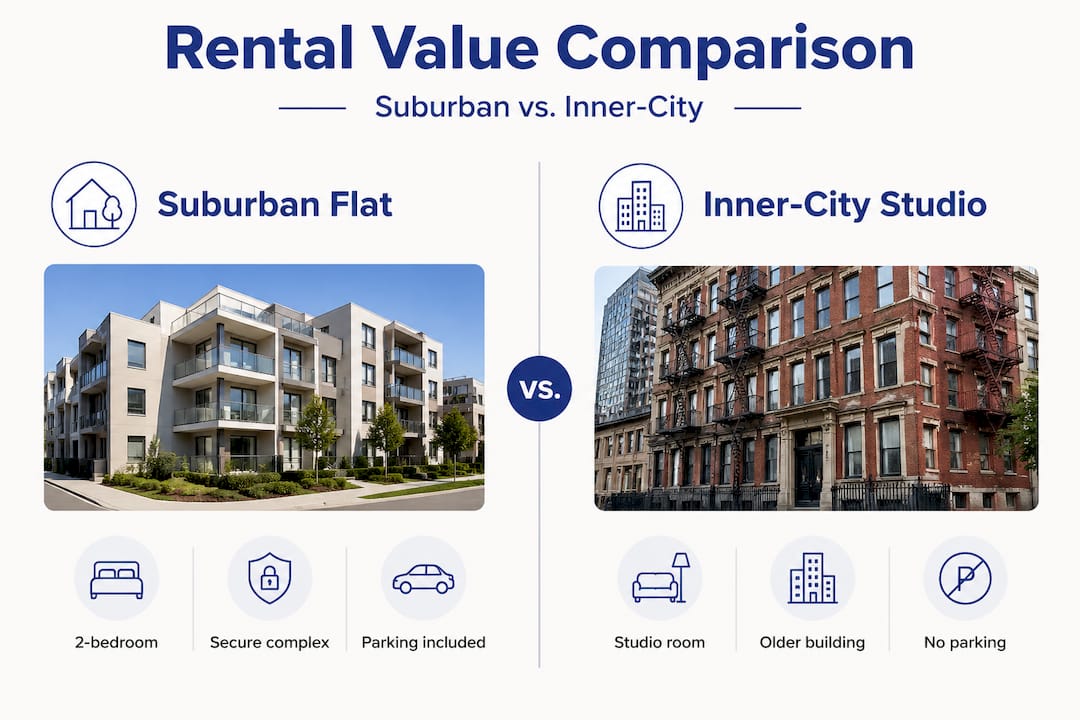
The Rental Housing Act is explicit that tribunal rulings must be just and equitable, considering return on investment and market conditions. A table like the one above, backed by screenshots from property portals and dated notes, gives you a defensible paper trail.
Useful tools to build into your process include a simple spreadsheet to track comparables with dates, regular reviews of property portals, agent briefings once or twice a year, and a review of your rental insurance options to ensure your policy reflects the actual value of your rental income.
What most landlords miss about fair rental value
Here is the perspective that most guides will not give you. The biggest mistake landlords make is not setting the wrong rent figure. It is assuming that being right is enough.
Landlords who know their rent is fair, because they have done the mental maths or spoken to a friend in the industry, often believe they are protected. They are not. The Rental Housing Tribunal is not interested in your confidence. It is interested in your evidence. A landlord relying on memory, hearsay, or general market sentiment is in a dangerously weak position, even if their rental amount is objectively reasonable.
Documented comparables and written notices provide the most defensible position in rental disputes. This is not just legal theory. It is the practical difference between winning and losing at a tribunal. Process matters as much as substance. If you cannot show your workings, the Tribunal may assume you have none.
Rental disputes are also rising in South Africa as economic pressure mounts on tenants. More tenants are disputing increases not because the amounts are unreasonable, but because they are looking for any procedural weakness they can exploit. A missed notice period, an undated communication, or an informal message via WhatsApp could undermine an otherwise legitimate rental increase.
This is why thinking about why insure rental income as part of your overall strategy matters so much. Insurance does not replace documentation, but it does provide a crucial financial buffer when disputes drag on, tenants withhold rent during proceedings, or unexpected costs arise. The landlords who come through disputes intact are those who combined strong documentation with financial protection.
Protect your fair rental value (and your income)
Defending fair rental value means taking action long before a dispute arises. Building the right evidence base is essential but so is having a financial safety net in place when things go wrong despite your best efforts.

Rental Income Insurance is designed specifically for landlords who understand that even a well-managed property carries risk. Whether a tenant disputes a rental increase, stops paying rent entirely, or abandons the property, your income should not be the casualty. Our cover addresses tenant non-payment, early lease termination, and property abandonment, giving you the stability to manage your property confidently. You can request an insurance quote today and find out exactly what cover suits your circumstances. For a deeper look at how income protection works in practice, the rental income protection guide gives you a thorough, practical overview of your options as a South African landlord.
Frequently asked questions
Is there a maximum limit for rent increases in South Africa?
There is no fixed national cap on rent increases in South Africa. All increases must be fair, reasonable, and supported by current market conditions and your lease agreement.
What type of evidence will help support my fair rental value if challenged?
Documented comparables and written notices are the strongest evidence you can produce in a Rental Housing Tribunal dispute. Supporting market data gathered from current property portals adds further weight to your position.
How do market conditions affect fair rental value?
Demand, location, and current market trends are central to any fair rental value determination, as supply/demand conditions must be considered when setting a justifiable rental amount under South African law.
What happens if a tenant disputes my rent increase?
The Rental Housing Tribunal will assess your process and evidence. Maintaining fair process documentation including written notices and comparable records gives you the strongest chance of a successful outcome.
Recommended
- How to Protect Rental Income: Secure Your Earnings Now – Rental Income Insurance
- Rental Protection Schemes: Safeguarding Your Income – Rental Income Insurance
- 7 Key Protections for Property Income Every Landlord Needs – Rental Income Insurance
- Essential Steps to Safeguard Rental Income Effectively – Rental Income Insurance