
TL;DR:
- Unoccupied property insurance provides essential coverage beyond standard policies’ vacancy limits, protecting against risks like fire, vandalism, and water damage during extended empty periods. It requires active risk management, including regular inspections and proper security measures, to prevent claims and maintain coverage validity. Landlords often underestimate this risk, risking costly claims if they fail to notify insurers or implement preventive measures during vacancy.
Unoccupied property insurance is specialist coverage that protects a property left empty beyond the limits set by a standard home or landlord policy. Most standard policies restrict cover after 30 to 60 days of vacancy, stripping away protection for fire, theft, vandalism, and water damage at precisely the moment a property is most vulnerable. For landlords managing rental portfolios, this gap is not a technicality. It is a direct financial threat. Whether a property sits empty between tenancies, awaits renovation, or is listed for sale, unoccupied property insurance fills the coverage void that standard policies leave behind.
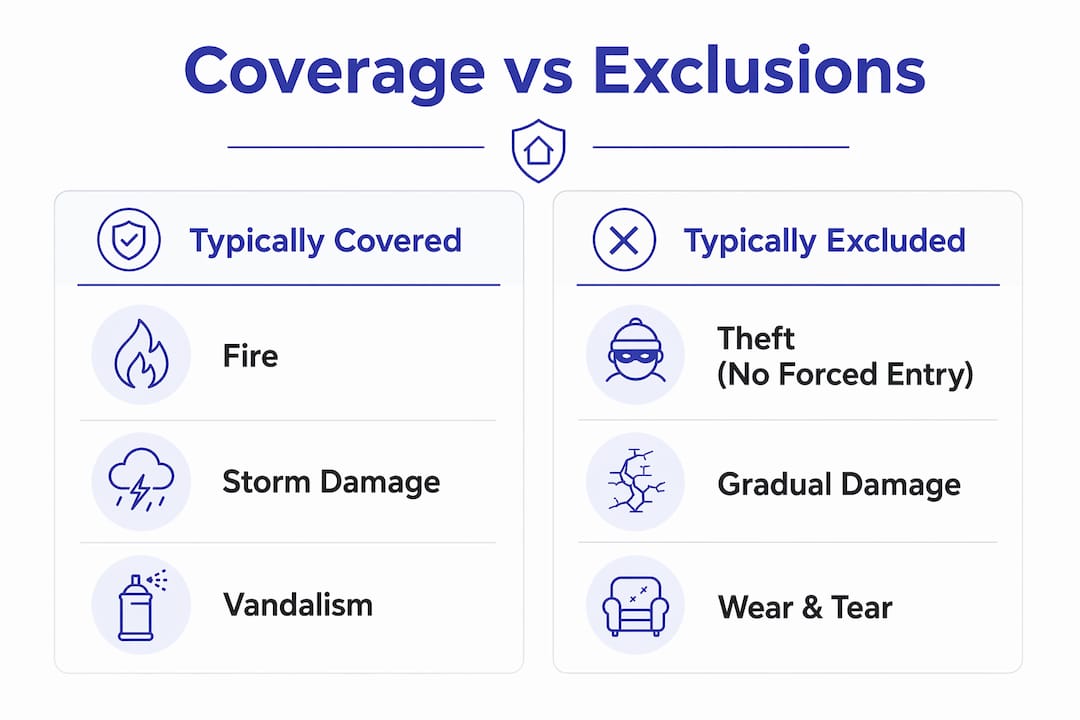
What does unoccupied property insurance cover?
Unoccupied property insurance, sometimes called empty property insurance or vacant property coverage, provides protection for perils that standard policies withdraw once a property exceeds the permitted vacancy period. Typical inclusions are fire, storm and flood damage, escape of water, malicious damage, and public liability, often up to £2 million. These are the risks most likely to cause serious financial loss when no one is present to catch problems early.
Exclusions are equally important to understand. Common exclusions include theft without forced entry, gradual deterioration, and high-value items unless specifically declared. This means a burglar who enters through an unlocked door may not trigger a valid claim. Gradual damp or slow pipe corrosion is similarly excluded because these are maintenance failures rather than sudden events.
There is also a technical distinction between “unoccupied” and “vacant” that affects your coverage. An unoccupied property still contains furniture and fittings but has no resident. A vacant property is empty of both people and possessions. After 60 days, insurers may reclassify a property as vacant, which can downgrade cover for perils such as theft and vandalism unless you have the appropriate endorsement. Knowing which classification applies to your property determines which policy you actually need.
| Risk | Typically covered | Typically excluded |
|---|---|---|
| Fire and explosion | Yes | No |
| Storm and flood damage | Yes | No |
| Escape of water (sudden) | Yes | Gradual leaks or deterioration |
| Malicious damage and vandalism | Yes (with conditions) | If property is classified vacant beyond policy limits |
| Theft | Forced entry only | Theft without forced entry |
| Public liability | Yes, up to £2 million | Liability from neglect or non-compliance |
| Gradual deterioration | No | Always excluded |
Pro Tip: Declare all high-value items and infrastructure such as copper pipework when taking out a policy. Undeclared valuables are a frequent reason claims are reduced or rejected.
Why are unoccupied properties at higher risk?
Vacant properties face significantly greater exposure to damage and criminal activity than occupied ones. 25% of the estimated £2 billion in annual UK damages from vandalism and arson involves vacant properties. That figure represents a disproportionate share of losses for a subset of the total housing stock, which tells you something important: absence itself is a risk factor.

The reasons are straightforward. No occupant means no one to notice a slow leak, a broken window, or signs of attempted entry. Small problems compound quickly. A minor roof defect in October becomes a collapsed ceiling by February. Sedgwick describes this as a “window of vulnerability” where unnoticed minor issues escalate into catastrophic damage during transitions such as renovation, probate, or sale.
The specific vulnerabilities of an unoccupied property include:
- Accumulated mail attracting squatters and signalling absence to opportunistic criminals
- Unmaintained entry points such as loose window frames or unlocked outbuildings
- Unmonitored utilities including water systems prone to freezing or leaking in winter
- Copper pipework and electrical fittings which are common theft targets in vacant buildings
- Absence of lighting and activity making the property an obvious target for arson and vandalism
Legal liability is another underappreciated risk. If a trespasser is injured on your unoccupied property, you may face a compensation claim. Failing to notify your insurer of the change in occupancy can invalidate your cover entirely, leaving you personally liable for both the damage and any legal costs.
Pro Tip: Arrange for a trusted person to collect or redirect mail within the first week of vacancy. Jensten Underwriting notes that accumulated mail is one of the primary signals that attracts squatters and vandals, and addressing it costs almost nothing.
“Vacant buildings require active risk management in addition to insurance. Owners must move beyond passive reliance on a policy to prevent minor problems from becoming major claims.” — Sedgwick, vacancy risk specialists
How to reduce risk in an unoccupied property
Insurance covers the financial consequences of damage. It does not prevent the damage itself. Proactive risk management is what keeps claims from arising in the first place, and it also keeps your policy valid. Insurers impose specific conditions on unoccupied properties, and failing to meet them can void a claim even when the policy is active.
Follow these steps to manage an unoccupied property effectively:
- Notify your insurer immediately when a property becomes unoccupied. Failing to do so is the single most common reason claims are denied. Insurers need to know the change in occupancy status to apply the correct terms.
- Conduct regular inspections at the frequency your insurer specifies, typically weekly or fortnightly. Insurers mandate inspection logs as proof of active management. Keep written records with dates and photographs.
- Drain water systems or insulate pipes before winter. Burst pipes are the leading cause of escape-of-water claims in unoccupied properties. If the property will be empty through cold months, consider a full system drain.
- Secure all entry points including gates, outbuildings, and secondary doors. Fit deadbolts, board up vulnerable windows if necessary, and consider a monitored alarm system.
- Install CCTV or sensor lighting at visible entry points. Visible security measures deter opportunistic criminals and are viewed favourably by underwriters.
- Remove or secure valuables including copper pipework, electrical fittings, and any portable items of value. Ecclesiastical and other specialist insurers recommend removing these before vacancy begins.
- Manage mail and deliveries by redirecting post and cancelling regular deliveries. A letterbox overflowing with mail is one of the clearest signals that a property is unattended.
- Keep the garden and exterior maintained to avoid the property looking abandoned. Overgrown hedges and peeling paintwork attract attention from the wrong people.
Pro Tip: Create a simple inspection log template and keep it on your phone. Date, photograph, and note any observations at each visit. This record is your primary defence if an insurer queries whether conditions were met before a claim.
How does unoccupied insurance compare to standard landlord cover?
Standard landlord insurance and home insurance are designed for properties in active use. They include vacancy clauses that restrict or void cover once a property has been empty for a defined period, typically 30 to 60 days. Beyond that threshold, key perils such as theft, vandalism, and escape of water are often excluded or subject to reduced limits.
Unoccupied property insurance is purpose-built for extended vacancy. It accepts the higher risk profile of an empty property and prices the premium accordingly. The trade-off is that premiums are higher than standard cover, and the policy conditions are stricter, particularly around inspections and security.
| Feature | Standard landlord or home insurance | Unoccupied property insurance |
|---|---|---|
| Vacancy allowance | 30 to 60 days | Designed for extended vacancy |
| Theft cover | Included while occupied | Forced entry only when unoccupied |
| Vandalism cover | Included | Conditional on security compliance |
| Escape of water | Included | Covered; winterisation may be required |
| Inspection requirement | None | Weekly or fortnightly, with logs |
| Premium level | Standard | Higher, reflecting increased risk |
| Policy duration | Annual, ongoing | Often short-term or flexible |
Understanding the difference between rental and landlord insurance types is useful context here. Many landlords assume their existing policy covers all scenarios. It does not. The moment a tenancy ends and the property sits empty, the clock starts on the vacancy clause. Specialist property owner insurance types exist precisely to address this gap.
Landlords should also consider that unoccupied property insurance does not replace rental income protection. The two products address different risks. One protects the building during vacancy. The other protects your income stream when tenants fail to pay or vacate unexpectedly. Both are worth holding simultaneously if your portfolio includes properties that cycle through vacancy periods.
Key takeaways
Unoccupied property insurance is the only reliable way to maintain full protection for a property once standard policy vacancy limits expire.
| Point | Details |
|---|---|
| Standard policies have vacancy limits | Cover for theft, vandalism, and water damage is typically voided after 30 to 60 days of vacancy. |
| Unoccupied versus vacant classification matters | After 60 days, a property may be reclassified as vacant, affecting which perils are covered. |
| Inspection logs are non-negotiable | Insurers require formal inspection records; missing these can invalidate a claim even with an active policy. |
| Proactive risk management is required | Insurance alone is insufficient; security measures, pipe protection, and mail management reduce both risk and premium. |
| Notify your insurer immediately | Failing to report a change in occupancy is the most common cause of claim denial for unoccupied properties. |
Why landlords underestimate this risk more than they should
I have spoken with enough landlords to know that unoccupied property insurance is consistently the last thing on their list when a tenancy ends. The focus goes to finding the next tenant, managing the void period financially, and sorting out any repairs. The insurance question gets deferred, often with the assumption that the existing policy “probably still covers it.”
That assumption is wrong, and it is expensive when tested. The vacancy clause in a standard policy is not a grey area. It is a hard limit, and insurers apply it without sympathy when a claim arrives. I have seen landlords face five-figure repair bills for water damage that occurred during a three-month void period, only to discover their claim was invalid because they never notified their insurer of the change in occupancy.
The other mistake I see regularly is treating insurance as a substitute for management. A policy does not stop a pipe from bursting or deter a vandal. What it does is cover the financial consequences after the fact. The landlords who come out of vacancy periods with the fewest problems are the ones who treat the empty property as an active responsibility, not a passive asset waiting for a new tenant.
The cost of specialist unoccupied cover is real, but it is modest compared to the cost of an uninsured claim. If your property will be empty for more than 30 days, the conversation with your insurer is not optional. It is the first call you should make.
— Coert
Protect your investment with Rentalincomeinsurance

Unoccupied periods are one of the most financially exposed phases of property ownership. Rentalincomeinsurance helps landlords protect both their property and their income stream during these gaps. While unoccupied property insurance covers the building itself, rental income insurance protects the revenue you depend on when tenants fail to pay, leave early, or abscond. The two work together to give you complete financial protection across the full vacancy cycle. If you want to understand exactly what cover is right for your situation, request a personalised quote and get clarity on your options today.
Watch this short overview to see how rental income protection works in practice:
https://youtu.be/ej04S_af4qM
FAQ
What is unoccupied property insurance?
Unoccupied property insurance is specialist cover for properties left empty beyond the vacancy limits of a standard policy, typically 30 to 60 days. It protects against risks such as fire, escape of water, vandalism, and public liability that standard policies exclude during extended vacancy.
Does unoccupied insurance cover theft?
Most unoccupied property policies cover theft only where there is evidence of forced entry. Theft without forced entry, such as entry through an unlocked door or window, is a standard exclusion across most specialist policies.
How long can a property be empty before standard cover is void?
Standard home and landlord insurance policies typically restrict cover after 30 to 60 days of vacancy. Beyond this period, key perils including vandalism, theft, and water damage are often excluded or voided unless you have notified your insurer and arranged appropriate cover.
What are the main risks of leaving a property unoccupied?
The primary risks include fire, burst pipes, escape of water, vandalism, arson, and theft of copper pipework or electrical fittings. Vacant properties account for a disproportionate share of UK vandalism and arson claims, making specialist cover and active risk management both necessary.
Do I need to tell my insurer when my property becomes unoccupied?
Yes. Failing to notify your insurer of a change in occupancy can invalidate your policy entirely, leaving you personally liable for damage costs and any legal claims including trespasser injuries. Notification should happen as soon as the property becomes empty.