
TL;DR:
- Tenant risk in South Africa’s rental market has increased, with over 26% of applicants flagged as high-risk in early 2025. Rental specialists help landlords mitigate financial losses, legal issues, and property damage by conducting thorough screening and managing arrears effectively. Choosing a qualified, experienced rental professional is essential for protecting rental income and ensuring property stability.
Tenant risk in South Africa’s rental market has reached levels that most landlords simply aren’t prepared for. With 26% of rental applicants now flagged as high-risk in early 2025, the odds of placing a problematic tenant have never been higher. Many property owners still believe they can manage tenant selection and day-to-day rental administration on their own, but the data tells a different story. This article explains why rental specialists have become a critical line of defence for landlords who want to protect their income, avoid costly disputes, and ensure their properties remain financially viable.
Table of Contents
- Understanding the rental risk landscape in South Africa
- What do rental specialists actually do?
- How specialists minimise tenant risk and secure rental income
- Choosing the right rental specialist for your needs
- Our view: Why landlords can’t afford to ‘go it alone’
- Secure your rental income with specialist support
- Frequently asked questions
Key Takeaways
| Point | Details |
|---|---|
| Tenant risk is rising | More than a quarter of applicants are now high-risk, making informal management risky. |
| Specialists screen better | Rental specialists catch red flags non-experts often miss and apply formal processes. |
| Aligned with insurance | Working with experts improves access to comprehensive rental income insurance. |
| Choose carefully | Selecting a qualified, reputable specialist is vital for your investment’s security. |
| Avoid costly mistakes | DIY management can lead to larger losses compared to using professional support. |
Understanding the rental risk landscape in South Africa
South Africa’s rental market is facing genuine pressure. Economic strain, rising unemployment, and a cost-of-living squeeze have pushed a growing number of tenants into financial difficulty. The result is a wave of problematic rental applications that landlords are increasingly unprepared to handle without professional support.
A high-risk tenant, in practical terms, is someone with a poor credit history, a record of late or missed payments, prior evictions, or a pattern of disputing lease terms. These are not rare exceptions. According to recent reporting, rental applicants high-risk in Q1 2025 accounted for more than a quarter of all applications. That statistic deserves serious attention. One in four applicants you receive may be carrying financial red flags that informal checks simply won’t uncover.
What’s at stake when a high-risk tenant slips through? The list is significant:
- Lost rental income for months, sometimes years, while eviction proceedings drag on
- Legal fees that can run into tens of thousands of rands
- Property damage beyond what a deposit can cover
- Administrative burden of managing arrears, correspondence, and court processes
- Emotional stress from prolonged disputes and uncertainty
“The single biggest risk to any buy-to-let investment isn’t market fluctuations or interest rates. It’s placing the wrong tenant.”
Informal management strategies, such as relying on gut instinct, asking a friend for a reference, or running a quick Google search, are wholly inadequate in today’s environment. The tenant non-payment guide shows just how complex and costly recovery becomes once a default begins. Formal processes, expert tools, and professional judgement are no longer optional extras for serious landlords. They are essential.
What do rental specialists actually do?
Understanding the risks clarifies why expert involvement is vital. Now, let’s clarify precisely what rental specialists offer landlords who want to manage their properties effectively.
A rental specialist is more than a letting agent. They are trained property professionals who manage the full lifecycle of a tenancy, from screening applicants to enforcing lease terms and handling arrears. Their process is structured, documented, and designed to reduce financial risk at every stage.
Here is a practical breakdown of what a specialist does:
- Credit and background screening using accredited bureaus, employment verification, and rental history checks
- Risk profiling based on industry data and the screening process for tenants that examines affordability ratios and payment patterns
- Lease drafting and negotiation that ensures terms are legally sound and enforceable
- Monthly rent collection with formal escalation procedures when payments are late
- Arrears management including letters of demand, structured payment arrangements, and legal escalation
- Liaison with insurers when claims become necessary under a rental income protection policy
This structured approach is why specialist-managed properties consistently outperform self-managed ones when it comes to default rates and income stability. Given that over a quarter of applicants now carry measurable risk, having someone in your corner who can accurately assess that risk is invaluable.
“Rental specialists don’t just find tenants. They find the right tenants and build the structures that keep landlords protected when things go wrong.”
Pro Tip: Ask any specialist you’re considering what their arrears escalation process looks like. A vague or generic answer is a red flag. You want someone who can describe, step by step, what happens on day one, day seven, and day thirty of a late payment.
Understanding the role of rental agents in claims is also worth your time. When a tenant defaults and you need to activate an insurance policy, a specialist’s documented records, communication history, and formal notices are what make a claim straightforward rather than disputed.
How specialists minimise tenant risk and secure rental income
With their responsibilities in mind, it’s crucial to see how these experts actually improve landlord outcomes in concrete, measurable ways.

The contrast between self-managed and specialist-managed properties tells a clear story:
| Factor | Self-managed | Specialist-managed |
|---|---|---|
| Tenant screening depth | Basic ID and reference check | Full credit, employment, and rental history |
| Arrears response time | Days to weeks | 24 to 48 hours |
| Legal action speed | Often delayed | Structured, documented escalation |
| Insurance claim support | Landlord navigates alone | Specialist provides documentation |
| Default rate | Higher without formal tools | Lower with risk profiling |
| Income continuity | Vulnerable to gaps | Actively protected |
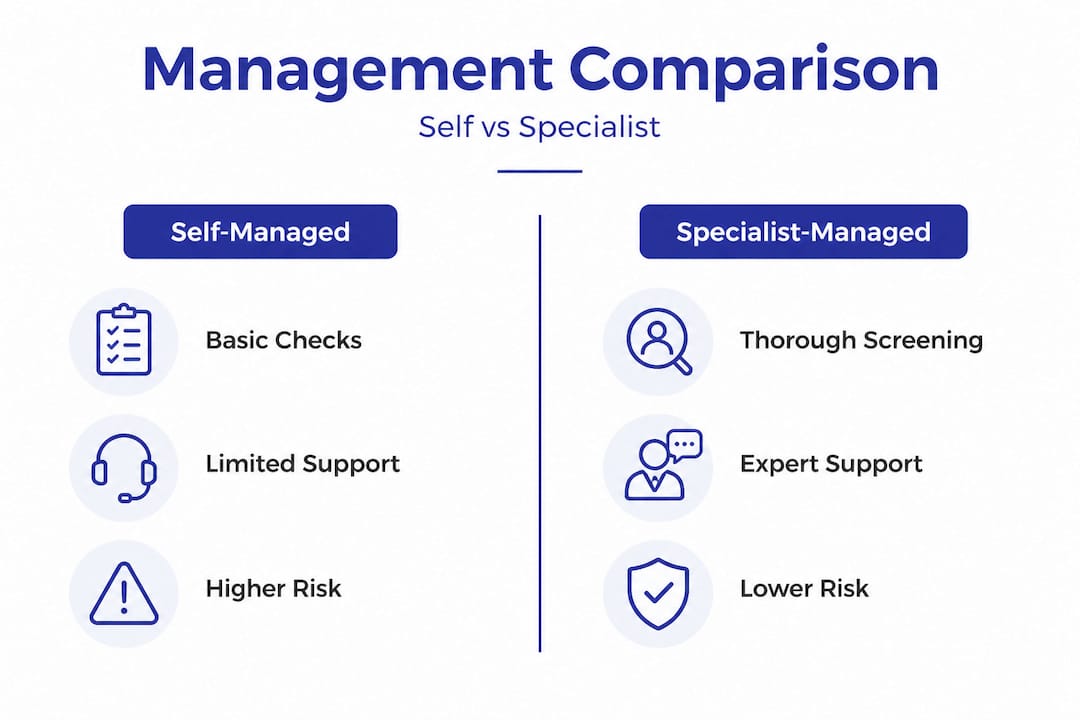
Consider a typical scenario. A landlord in Johannesburg receives six applications for a two-bedroom property. Two of those applicants appear credible on the surface, decent jobs, presentable manner, verbal confirmation of previous tenancy. However, a proper credit bureau check reveals that one has three active judgements and a history of skipping out of leases. Without a specialist running that check, the landlord might place that tenant and face months of unpaid rent within a year.
Research comparing renting out yourself vs using a property manager consistently shows that the cost of professional management is far outweighed by the losses it prevents.
Specialists also understand insurance in property management at a practical level. They know what documentation insurers require, how to present claims clearly, and how to minimise the time between a default event and a pay-out. A landlord managing alone often struggles to meet claim requirements because they haven’t maintained the right records or followed the required escalation steps.
Given the current reality that rental applicants flagged as high-risk are at record levels, having a specialist in place isn’t an indulgence. It’s risk management.
Pro Tip: If you already have a rental income protection policy, check whether your insurer requires a formal lease agreement and documented arrears notices as conditions for a claim. A specialist will ensure those boxes are always ticked.
Key steps for working effectively with a rental specialist:
- Set clear expectations about communication frequency and reporting
- Ensure they use accredited credit bureaus for screening
- Confirm they have experience with the Rental Housing Act and eviction proceedings
- Align on how insurance claims will be handled if a default occurs
- Review their management agreement carefully before signing
Choosing the right rental specialist for your needs
Once convinced of the value they bring, the next step is knowing how to select the right rental specialist for your circumstances.
Not all rental specialists are equal. Some are well-resourced agencies with established screening systems and insurer relationships. Others are individual agents with limited tools and no formalised risk processes. Choosing poorly can mean paying for the appearance of expertise without the substance.
Here is what to look for:
- Registered credentials with the Estate Agency Affairs Board (EAAB), the regulatory body for property practitioners in South Africa
- Proven track record with verifiable references from other landlords, ideally in your area
- Knowledge of rental income insurance and experience guiding landlords through claims
- Transparent fee structure with no hidden charges for administration, maintenance coordination, or legal escalation
- Local market expertise because a specialist who knows your suburb understands tenant demand, appropriate rental pricing, and common local issues
Use this quick reference when evaluating candidates:
| Evaluation criterion | What to look for | Red flag |
|---|---|---|
| Credentials | EAAB registered, FFC current | No registration or expired certificate |
| Screening tools | Accredited credit bureau access | Manual checks only |
| Insurance knowledge | Familiar with rental income policies | Unaware of insurer requirements |
| Legal capability | Experience with eviction applications | No legal escalation process |
| Communication | Regular written reports | Verbal updates only |
| References | Verifiable from landlords | Vague or unavailable |
Questions every landlord should ask before signing an agreement:
- How many properties do you currently manage, and what is your arrears rate?
- Which credit bureaus do you use for tenant screening?
- How quickly do you act when a tenant misses a payment?
- Can you walk me through your eviction process?
- Are you familiar with the rental income insurance claims process?
A good specialist will answer these questions directly and in detail. Evasive or vague responses are a warning sign. Transparency about process and track record is a minimum standard, not a bonus.
Comparing rental insurance options is also worth doing alongside your specialist search. The best specialists actively help landlords understand their cover and ensure that properties are managed in a way that keeps insurance valid and claims straightforward. Understanding how to cover your financial obligations as a landlord reinforces why formal specialist partnerships and insurance coverage go hand in hand.
Our view: Why landlords can’t afford to ‘go it alone’
After guiding you through practical decisions, let’s dig deeper into what experience and industry wisdom reveal about the real cost of managing alone.
There is a persistent myth among South African landlords that using a rental specialist is a luxury, fine if you have multiple properties but unnecessary for a single buy-to-let investment. This belief is not just wrong. It is expensive.
The real calculation isn’t specialist fees versus no fees. It is specialist fees versus the cost of a six-month default, an eviction application, property repairs, and a gap in income while you find a new tenant. When you run those numbers honestly, professional management almost always comes out cheaper.
What most people miss is that risk management in property isn’t just about screening tenants better, although that matters enormously when over a quarter of applicants now carry measurable risk. It is about having systems, documentation, and relationships in place so that when something goes wrong, you can respond quickly and effectively rather than scrambling to catch up.
Experienced landlords who have managed properties for decades are not immune to this. In fact, some of the costliest mistakes we hear about come from confident, long-term landlords who trusted their instincts over formal process. Instinct can’t read a credit report. It can’t identify a pattern of lease disputes across multiple prior landlords. It can’t tell you that an applicant’s salary has already been attached by creditors.
The benefits of being an insured landlord compound when paired with specialist management. Insurers recognise the lower risk profile of professionally managed properties. That translates into better terms, faster claims, and fewer disputes. Going it alone removes that advantage entirely.
Our honest view is this: the rental market in South Africa has become too complex and too risky for a solo approach to be considered sensible. The landlords who protect their income most effectively are those who invest in the right expertise and the right cover. Everything else is a gamble with your own money.
Secure your rental income with specialist support
You’ve seen the risks, the numbers, and the real cost of managing without expert support. The next step is taking practical action to protect what you’ve built.

At Rental Income Insurance, we work with landlords who are serious about protecting their rental income from tenant non-payment, early lease termination, and absconding tenants. Whether you’re placing your first tenant or managing a portfolio of properties, we provide the cover and guidance that closes the gap between what can go wrong and what you can recover. Visit our rental income protection guide to understand exactly what your options are, then request a quote tailored to your property and circumstances. Specialist support and the right insurance policy together are the most powerful combination a landlord can have.
Frequently asked questions
What makes a tenant high-risk?
A high-risk tenant typically has a history of late or missed payments, active judgements, prior evictions, or disputed lease records. With rental applicants now flagged as high-risk at record levels, formal screening is essential to identify these factors before signing a lease.
Can landlords screen tenants themselves?
Basic checks are possible, but specialist screening tools access credit bureaus, employment verification, and rental history databases that most individual landlords simply cannot access on their own.
Does using a rental specialist affect insurance premiums?
Many insurers offer more favourable terms when a qualified professional handles tenant selection and ongoing property management, because the risk profile of the property is genuinely lower.
What should I look for in a rental specialist?
Look for current EAAB registration, accredited credit bureau access, demonstrable knowledge of rental income insurance processes, and verifiable references from other landlords in your area.
Is working with a rental specialist worth the cost?
Specialist fees are consistently outweighed by the losses they prevent. A single avoided eviction, with its legal costs, income gap, and potential property damage, pays for years of professional management.
Recommended
- Key landlord responsibilities: protect your SA rental income – Rental Income Insurance
- How to Minimise Rental Risks for South African Landlords – Rental Income Insurance
- Benefits of Rental Protection: Complete South African Guide – Rental Income Insurance
- Why Rental Leases Matter for South African Landlords – Rental Income Insurance
- Success stories – Guestly Homes